Working from home without a spare room usually means the couch, the kitchen table, or a laptop balanced wherever it lands — and your focus pays for it by 3 p.m. A real home office needs about 10 square feet: one surface, one chair, storage that goes up instead of out, and a boundary your brain can recognize. These 13 desk and storage ideas build exactly that in a corner, a closet or a slice of living room, most for under $50 a piece. Pick your spot first; everything else follows.
1. Claim One Corner and Call It the Office
A home office starts as a decision, not a purchase: this corner, every workday, is work. Choose the spot with the best light and the least foot traffic — a living room corner, the end of a bedroom, a wide hallway landing. Mark it with a small rug or a change of wall color if you can. This is the same zoning logic as our studio apartment organization system: one space, clearly defined zones. A dedicated corner, even a tiny one, beats a big desk that migrates around the apartment.

2. Turn a Closet Into a Cloffice
The closet office — the cloffice — is the small-space MVP. Remove the doors, slide in a desk or a mounted shelf at sitting height, add a task light and one shelf above, and you have a private office that hides behind a curtain when guests come. A standard reach-in closet fits a 48-inch desk surface ($40 to $70 for a cut-to-fit board or slim desk) with room for shelves above. The layout tricks from our small closet organization ideas — double up the vertical space, use the door, keep zones strict — apply here word for word, just with a laptop where the sweaters used to be.

3. Mount a Fold-Down or Wall Desk
When floor space is truly zero, the desk itself can disappear. A wall-mounted fold-down desk ($50 to $110) gives you a 30-inch work surface that folds flat to a 4-inch profile at night; ladder desks lean against the wall with shelves built in above. Renters: look for over-door or clamp-on versions, or mount into studs and plan to patch two small holes later. A desk that folds away is also a boundary — work ends when the surface goes up.
4. Go Vertical With Shelves Above the Desk
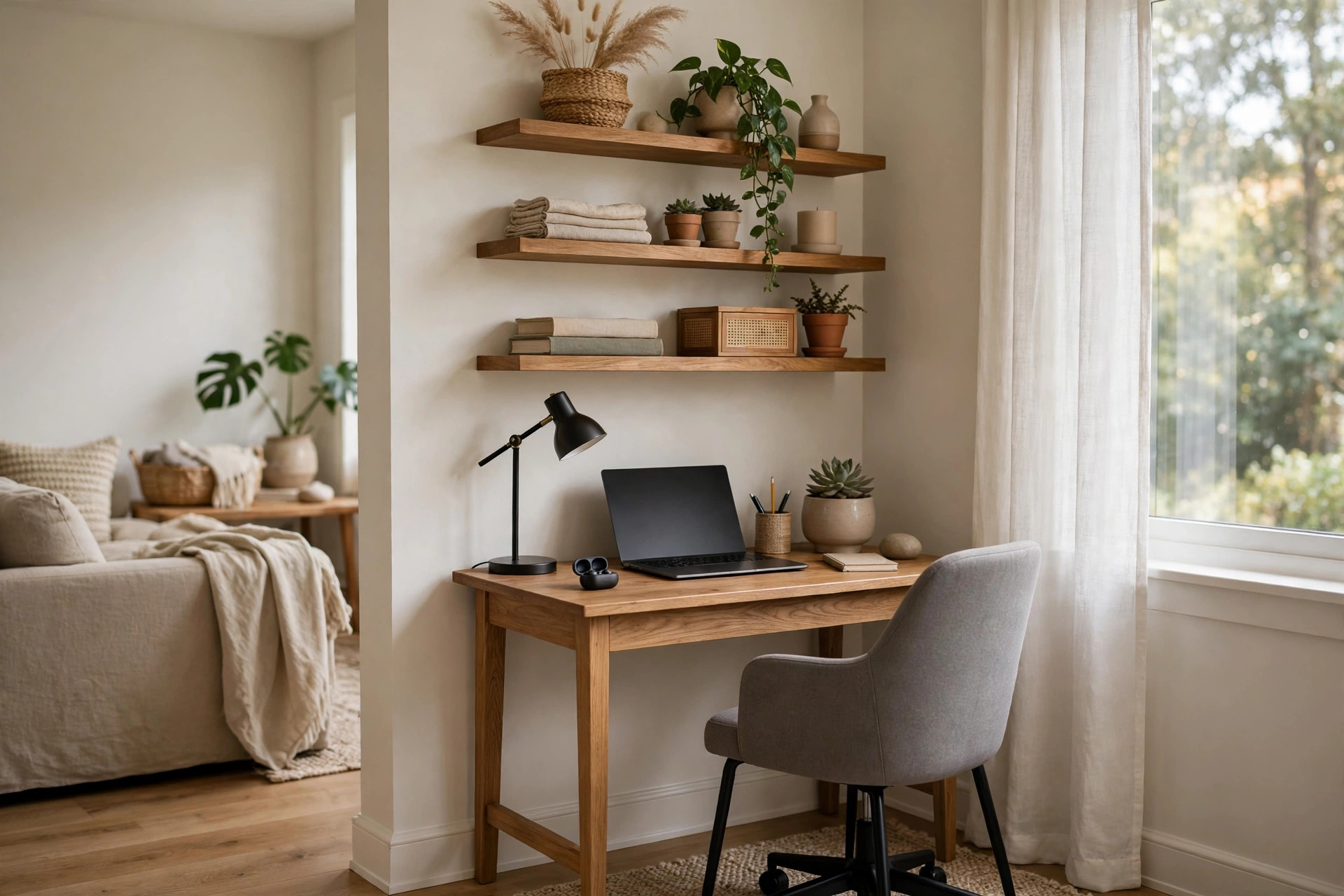
The wall above any desk holds two shelves’ worth of storage that most people leave empty. Two floating or bracket shelves ($15 to $30 a pair) take the printer paper, reference books, chargers and supplies off your work surface and put them within arm’s reach. This is the core principle of our vertical storage ideas: in a small space, height is free real estate. Keep the lowest shelf at least 18 inches above the desk so a laptop screen and lamp fit comfortably underneath.

5. Choose a Slim Desk With Real Drawers
If you buy one furniture piece, buy a narrow writing desk with drawers ($70 to $130) — 40 to 48 inches wide, 18 to 20 inches deep. Drawers are the difference between a desk that stays clear and one that becomes a shelf with a laptop on it: pens, notebook, charger and headphones disappear in ten seconds at shutdown. Ladder desks look airy but store nothing; in a small office, closed storage wins. Check knee space before buying — 24 inches wide and 27 inches high underneath is the comfort minimum.
6. Park a Rolling Cart Beside the Desk
A three-tier rolling cart ($20 to $35) is the small office’s filing cabinet, supply closet and printer stand in one 12-inch footprint. Top tier: daily supplies. Middle: notebooks and current projects. Bottom: paper, cables and back stock. Roll it beside the desk while you work, into a closet when you finish — the office literally leaves the room.
7. Hide Every Cord You Can
Nothing makes a tiny workspace feel chaotic like a nest of cables. A cable management box ($12 to $20) swallows the power strip and adapters; adhesive clips ($6 to $10) run the remaining cords along the desk’s back edge; velcro ties ($5) bundle the rest. Ten minutes of cord control makes a small desk look twice as organized, and cleaning around it becomes a 30-second job.
8. Put a Pegboard on the Wall for Tools and Notes
A pegboard panel ($15 to $30) above or beside the desk holds scissors, tape, headphones, sticky notes and your calendar in plain sight — off the surface, impossible to lose. Small baskets and hooks corral chargers and pens. Paint it the wall color for a built-in look, or a contrasting color to mark the office zone. Pegboards beat desk organizers because they store vertically and rearrange in seconds.
9. Pick a Chair That Supports You and Tucks Away
Your chair is the one place not to go ultra-cheap: eight hours in a dining chair will find every weak spot in your back. A compact task chair with lumbar support ($60 to $120) and no bulky arms tucks fully under most desks, returning your floor space at night. If the office is in the living room, choose a chair in a fabric and color that reads as furniture, not office equipment. A small cushion ($10 to $15) upgrades almost any chair while you save for a better one.
10. Light It Like You Mean It
Overhead rental lighting is flat, yellow and exhausting on video calls. A desk lamp with an adjustable arm ($15 to $30) and a daylight bulb puts light where the work is and makes your face look human on camera. Position it opposite your writing hand, and face a window if you can — side light is the most flattering. In a cloffice or dark corner, an adhesive LED strip under the shelf above ($8 to $14) brightens the whole nook.
11. Lift the Screen and Free the Surface
A laptop flat on a desk forces you to hunch and eats a third of the surface. A laptop stand or monitor riser ($20 to $40) raises the screen to eye level and creates a storage slot underneath for your notebook or keyboard. Add an external keyboard and mouse ($25 to $45 for a set) and a tiny desk suddenly works like a full setup — the single biggest comfort upgrade on this list.
12. Keep the Desktop to Five Things
Small desks stay clear by rule, not by willpower. The rule: five things may live on the surface — laptop or monitor, keyboard, mouse, one notebook or planner, and one drink. Everything else has a drawer, shelf, cart tier or pegboard hook to return to. Do a 60-second reset at shutdown: five things aligned, everything else home. When a sixth item tries to move in permanently, something else has to leave — surface space is the scarcest resource in a small office.
13. End the Workday With a Visible Boundary
The hidden cost of a small-space office is that work never leaves the room. Build an off switch: close the laptop, roll the cart away, fold the desk up or pull the cloffice curtain, and change one small thing — the lamp off, a different playlist on. A room divider or curtain ($25 to $60) between the desk and the rest of the room makes the boundary physical if your brain needs the help. In a small home, protecting your off hours is the entire point.
What to Avoid
Avoid working from the bed or couch as your permanent setup — your posture, sleep and focus all pay for it within a month. Avoid a big executive desk; depth you do not need becomes a clutter magnet. Avoid open storage everywhere: a small office with every supply on display always looks busy, so give most things a drawer, box or door to hide behind. Avoid skipping the light — one good lamp fixes more video calls than any organizer. And avoid letting work paper colonize the home; one inbox tray at the desk, emptied weekly, is the whole system.
Frequently Asked Questions
How small can a home office actually be? Surprisingly small: a 40-inch desk needs a footprint of roughly 4 by 2 feet, plus chair space — about 10 to 12 square feet total. Closets, wide hallway ends, the corner beside a window and the foot of a bed all qualify. What matters is not size but definition: a surface, a chair, storage above, and a spot that is only for work.
What is a cloffice, and how do I make one comfortable? A cloffice is an office built inside a closet. Remove the doors (or replace them with a curtain), fit a desk surface at about 29 inches high, add shelves above, a task light and an LED strip, and hang a pegboard inside for supplies. Comfort comes from light and air: choose a chair that fits the width and keep colors light so it feels like a nook, not a cupboard.
What desk size works best in a small space? A desk 40 to 48 inches wide and 18 to 20 inches deep fits a laptop or monitor, a notebook and a lamp without crowding. Shallower than 16 inches feels cramped with an external keyboard; deeper than 24 inches wastes floor space and collects clutter. If two people share, two small desks beat one big shared surface.
How do I keep a tiny desk from getting cluttered again? Give everything a home that is not the surface — drawer, shelf, cart or pegboard — and run the five-things rule with a 60-second shutdown reset. Most tiny-desk clutter is really a storage shortage one foot away from the desk. Fix the storage, and the reset takes care of itself.
How much does a small-space home office cost to set up? A comfortable basic setup runs $150 to $300: a slim desk or fold-down surface, a supportive chair, one lamp, two shelves and a rolling cart. Start with the desk, chair and light — about $120 — and add storage pieces over the next month as you learn what your workday actually uses. Nearly every piece is portable, so the investment moves with you.
Conclusion
A home office is not a room — it is a surface, a chair, vertical storage and a boundary, and all four fit into 10 square feet of almost any apartment. Claim your corner or closet this weekend, add the desk and light first, and let shelves, a cart and the five-things rule keep it clear. Save these ideas to your work-from-home board before your next setup day, and share them with a friend who is still working from the couch.